
How Much Is a Missed Call Actually Costing Your Business?
How Much Is a Missed Call Actually Costing Your Business?
You're on a job site. Your hands are full. The phone rings and goes to voicemail.
No big deal, right? You'll call them back later.
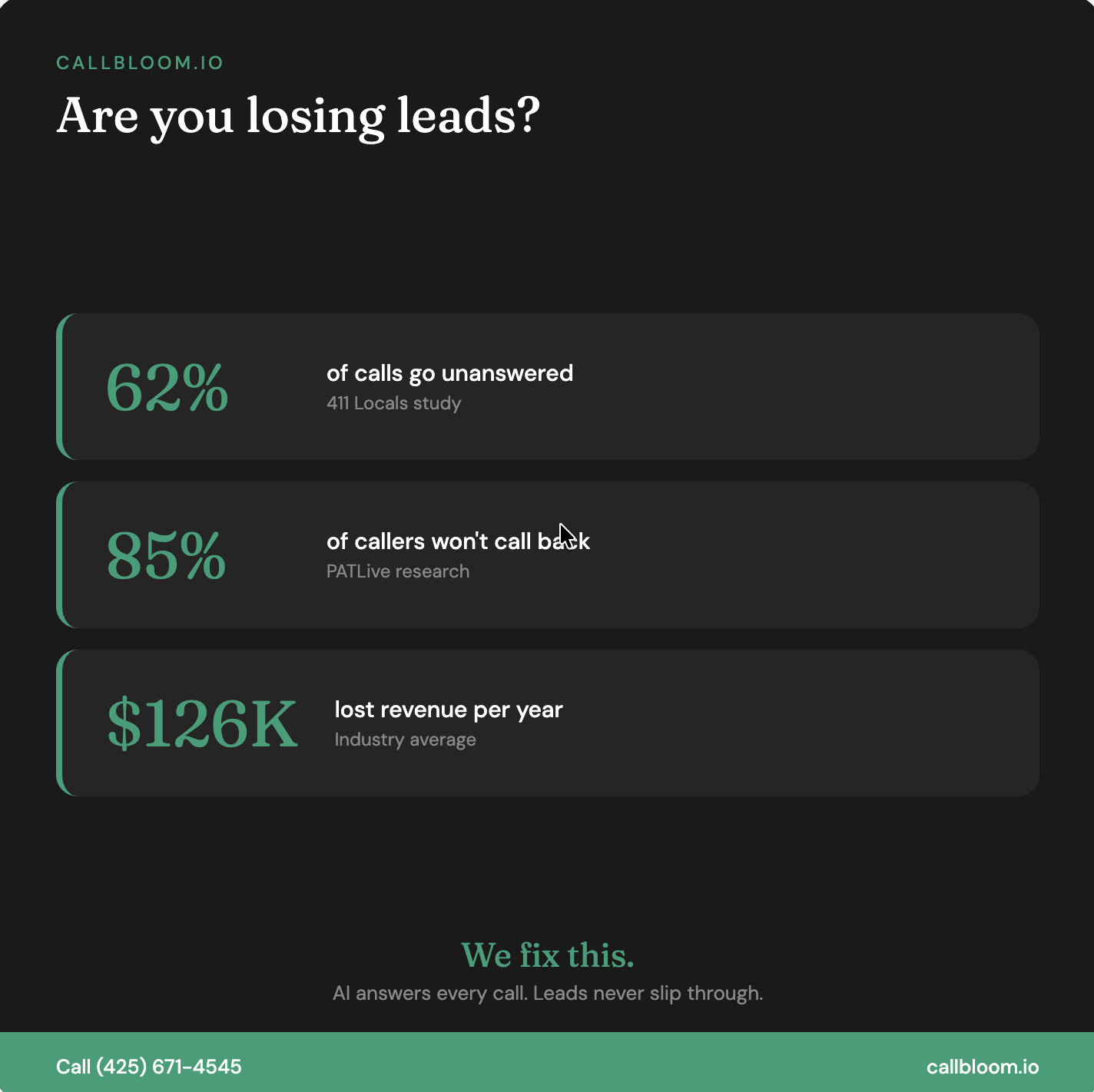
Except you probably won't. And even if you do, there's an 85% chance that caller has already moved on — most likely to your competitor down the street who actually picked up.
This isn't a hypothetical. It's happening to small businesses every single day, and the numbers are staggering.
The real numbers behind missed calls
According to a study by 411 Locals, 62% of phone calls to small businesses go unanswered. That's not a typo — more than six out of every ten calls ring out to voicemail or just keep ringing.
Here's where it gets worse. Research from PATLive found that 85% of people whose calls go unanswered will not call back. They don't leave a voicemail. They don't try again tomorrow. They just move on.
And where do they go? A study by BrightLocal found that 62% of consumers will call a competitor if their first call isn't answered.
Think about that for a second. You spent money on ads, SEO, Google Business Profile, word-of-mouth marketing, and truck wraps to make your phone ring. And when it finally does, nobody picks up.
What this actually costs in dollars
Let's run the math for a typical home service business.
Say you get 20 calls per week. At a 62% miss rate, that's about 12 missed calls every week. Over a year, that's roughly 624 missed calls.
If just 30% of those callers would have booked a job, that's 187 lost jobs. For a plumber averaging $350 per service call, that works out to over $65,000 in lost revenue. For an HVAC company averaging $500 per call, you're looking at $93,000 or more.
And if you factor in larger jobs like water heater installs, bathroom remodels, or system replacements, the real number can easily exceed $126,000 per year.
That's money you already spent to generate. Leads you already earned. Customers who already wanted to hire you. Gone — because nobody picked up the phone.
Why "I'll call them back" doesn't work
Most business owners think they can just return the call later. But there's a problem: speed matters more than almost anything else in lead conversion.
Research shows that businesses who respond to a lead within 5 minutes are 21 times more likely to qualify that lead compared to those who wait 30 minutes. After an hour, your chances of converting that lead drop by over 90%.
When someone has a leaking pipe, a broken AC unit, or a toothache, they're not going to wait around for you to call back at the end of the day. They're calling the next number on Google right now.
The real problem isn't laziness — it's logistics
Here's the thing: most small business owners aren't ignoring calls on purpose. They're on a job site with a customer. They're driving. They're in the middle of a repair. They're a one-person or small team operation and they physically cannot answer every call.
This is the fundamental tension of running a service business. The work that makes you money is the same work that prevents you from answering the phone. And every unanswered call is potential revenue walking out the door.
How businesses are solving this in 2026
The businesses that have figured this out aren't hiring full-time receptionists at $3,500 per month. They're using AI phone agents.
An AI phone agent is exactly what it sounds like: an AI-powered system that answers your phone 24 hours a day, 7 days a week. It sounds natural and conversational — most callers don't even realize they're talking to AI.
Here's what a modern AI phone agent can do:
Answer every single call, including nights, weekends, and holidays
Greet callers by your business name with your custom greeting
Answer common questions about your services, hours, and pricing
Collect the caller's name, phone number, and email
Book appointments directly on your calendar
Send confirmation texts and emails to the caller
Transfer urgent calls to you directly
The result? Zero missed calls. Every lead captured. Every potential customer taken care of — even when you're on a job, at dinner, or asleep.
The ROI math is simple
Let's say an AI phone agent costs you $497 per month. That's $5,964 per year.
If it captures just 5 extra jobs per month that you would have otherwise missed — at an average of $350 each — that's $21,000 in additional revenue per year. That's a 3.5x return on investment.
And realistically, if you're missing 62% of your calls, the actual number of recovered jobs is much higher than 5 per month.
What to do next
If you're a service business owner and you suspect you're losing calls, here's a quick test: call your own business after hours tonight. What happens? Does it ring forever? Go to a generic voicemail? If so, every potential customer calling you after 5 PM is getting the same experience.
At Callbloom, we set up AI phone agents for small service businesses. The setup takes about a week, and once it's running, it works around the clock without any effort from you.
Want to see how many leads you might be losing? We offer a free 15-minute Callbloom Checkup where we call your business after hours, review your website, and check your Google presence — then show you exactly where leads are slipping through.
No cost. No obligation. Just the data.
Book your free Callbloom Checkup at callbloom.io or call (425) 671-4545.
